
Cognitive Work Analysis [認知工作分析]
- CWA(Cognitive Work Analysis)的目的是指引工作場地中的技術設計。
定義
認知工作分析(Cognitive work analysis, CWA)是由 Rasmussen 等人(1994)所發展的一種工作分析架構。其目的是為了分析工作活動中的情境與認知性工作,以改善現有的工作資訊系統。
於1960年代,Rasmussen 與他的團隊,在丹麥 Riso 國家實驗室的研究,發展出認知工作分析方法。當時團隊研究的目的,是協助丹麥政府發展安全的核能發電工程。研究團隊發現,即使有了良好的系統設計,意外與變故仍然會發生在設計者沒有預料到的地方,此時作業人員必須能夠自行「完善整個系統」,即補足系統中缺乏的資訊與資源,以完成其工作(Sanderson, 2003)。因此,研究課題著重於,如何設計出一套系統,在意外發生時,能協助作業人員找出有效調適與處理。在現有研究方法不堪用的情況下,Rasmussen發展出認知工作分析此一分析架構。由於此一分析架構的應用性動機,認知工作分析在工業工程、系統工程、人機互動設計等研究領域受到注目,亦被稱為認知系統工程(cognitive systems engineering)。
此分析架構具有多重的理論基礎(Vicente, 1999; Sanderson, 2003),如系統化思維(general system thinking)、適應控制系統(adaptive control systems)、Gibson的環境心理學(Ecological Psychology);以及各種不同工作領域中支援系統開發的實地研究結果(Vicente, 1999)。儘管「認知工作分析」在名稱上有「認知」二字,然而認知科學對於認知工作分析的理論影響並不大。 Sanderson(2003)認為,認知工作分析並不是一種認知理論,也不是一種工作的認知模式,而是一種分析形塑工作相關認知的限制的方法。
資訊科學與認知工作分析
認知工作分析可用於研究在一個「資訊系統」當中的認知性工作。所謂「資訊系統」,可以是電腦或數位的,也能是社會的、心智上的系統。此「資訊系統」的功能在於促進並協助人與資訊互動。因此,一整座圖書館可以被視為是一個資訊系統;圖書館裡面的參考服務、網際網路、OPAC(線上共用編目系統)、編目部門,也能被視為是一個個不同的資訊系統。(Fidel & Pejtersen, 2004)
在資訊行為研究中,認知工作分析被視為一種綜合了認知取向與社會取向的多面資訊行為研究取向(Pettigrew, K. E., Fidel, R., &Bruce, H. ,2001)。認知工作分析以五個抽象層次檢視資訊行為:目的與限制、優先性、工作概念、工作程序、物質資源。即,認知工作分析能提供了資訊行為研究一分析認知行為與社會脈絡的分析架構。因為認知工作分析能探究特定領域情境中的資訊行為,因此其分析結果能優於普遍領域的資訊行為研究,也能對相同情境的資訊系統具有效度。同時認知工作分析也企圖透過在相同分析架構下的個別研究所結果,綜合出更具概化力的工作描述模式。
以資訊搜尋行為研究為例,認知工作分析的面向能呈現出資訊搜尋中的制約因素(constraint);這些制約由工作場地的外在環境開始,到內在的個人資源與角色價值。認知工作分析分析各種面向中的制約因素:如,工作環境會影響工作場地如何運作,且這種運作模式又形塑出角色所進行的工作任務。同時,工作任務也影響角色所能作出的決策,而這些決策又進一步影響搜尋行為。另一方面–由內而外的–,角色的個人特質(characteristics)也影響搜尋行為,一如社會組織對工作場所的影響(Fidel & Pejtersen, 2004)。
認知工作分析的面向(Dimensions)
認知工作分析(CWA)基於系統性思維,強調「整體大於個別元件的總和」,必須要能宏觀地檢視描述系統領域內各種複雜的因素。認知工作分析將工作系統分為七種不同的層次,或稱為七種觀點(Rasmussen, J., Pejtersen, A., & Schmidt, K., 1990),或稍後稱為七種面向(Fidel & Pejtersen, 2004)。此七種層次,由內在個人認知,到外在整體環境,有如洋蔥一般。
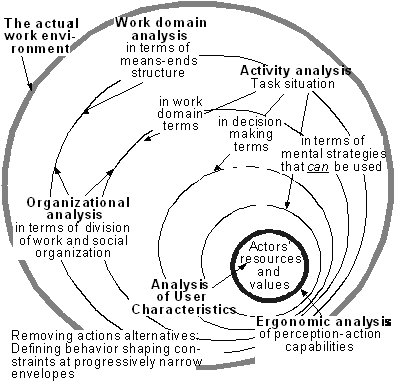

這些不同的層次,可以透過不同的方法釐清與掌握。若以由外而內的順序,分別為:
- 界定實際「工作」的涵蓋的領域範圍,釐清什麼是「工作」,什麼不算是「工作」。「工作」可以是研究想要探究的人類行為活動的主題或場域。
- 工作領域內的活動
- (1) 透過手段目的分析,辨識工作領域中的活動、物件與結構。
- (2)(3) 辨識工作活動時的任務、情境,與認知工作。
- (4) 分析與辨識工作時採用的心智策略。
- 工作領域的組織、角色與分工
- (5) 辨識在工作活動上,與認知活動上的分工與角色分配
- (6) 描繪組織文化與管理風格
- (7) 了解個體的工作能力與心理偏好

在資訊科學中的其他認知研究 Cognitive Research in Info. Sci.
- ARIST
- Cognitive information retrieval: Ingwersen, Peter. Cognitive Information Retrieval. vol.34, p.3
- Cognitive research: Allen, Bryce I.. Cognitive Research in Information Science: Implications for Design. Vol.26, p.3
- Pettigrew, K. E., Fidel, R., & Bruce, H. (2001). Conceptual frameworks in information behavior. Annual Review of Information Science and Technology(ARIST), Vol.35, pp. 43-78.
- Theories of Information Behavior.
參考書籍
Rasmussen
- Rasmussen, J., Pejtersen, A., & Schmidt, K. (1990). Taxonomy for cognitive work analysis. Riso National Laboratory.
- Rasmussen, J., Pejtersen, A. M., & Goodstein, L. P. (1994). Cognitive systems engineering. New York: John Wiley & Sons, Inc.
Vicente 1999
Cognitive work analysis - The framework of Work Analysis described in this book. It is based on the concept of Behavior-Shaping Constraints and contains models of the Work Domain, control tasks, Strategies, social-organizational factors, and Worker competencies in a single, integrated framework.
Fidel & Pejtersen
- Fidel, R., Mark Pejtersen, A., Cleal, B., & Bruce, H. (2004). A multidimensional approach to the study of human information interaction: A case study of collaborative information retrieval. Journal of the American Society for Information Science and Technology, 55(11), 939-953.
- Fidel, R., & Pejtersen, A. M. (2005). Cognitive work analysis. In K. E. Fisher, S. Erdelez & L. McKechnie (Eds.), Theories of information behavior (pp. 88-93): Informatio Today.
Sanderson
- Sanderson, P. (2003). Cognitive work analysis. In J. M. Carroll (Ed.), HCI models, theories, and frameworks: Toward a multidisciplinary science (pp. 225-264). San Francisco: Morgan Kaufmann.
- Sanderson, P. (1998). Cognitive work analysis and the analysis, design, and evaluation of human-computer interactive systems. Paper presented at the Computer Human Interaction Conference, 1998. Proceedings. 1998 Australasian.
Related Pages
backlinks
.
Tagged Posts
| 2023/01/29 13:29 | ||
| 2023/01/29 13:29 | ||
| 2023/01/29 13:29 | ||
| 2023/01/29 13:29 | ||
| 2023/01/29 13:29 | ||
| 2023/01/29 13:29 | ||
| 2023/01/29 13:29 | ||
| 2023/01/29 13:29 | ||
| 2023/01/29 13:29 | ||
| 2023/01/29 13:29 | ||
| 2023/01/29 13:29 |